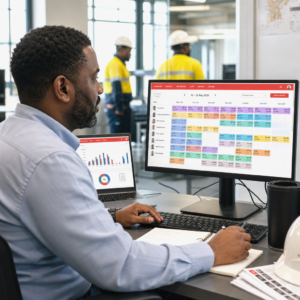
Workforce management fundamentals runs on six pillars: scheduling, attendance, compliance, visibility, communication, and payroll alignment. Get these right and operations stay controlled, labour costs stay visible, and payroll runs with fewer disputes.
These fundamentals apply across security, retail, and mining. The environments differ. The operating discipline stays the same. Every shift-based business needs the right person, at the right place, at the right time, under the right rules, with accurate records flowing into payroll.
What workforce management means in practice
Workforce management controls daily execution. It shapes who works, where they work, when they work, and how that time is recorded. It also determines how quickly managers can respond when reality changes.
In practice, that means:
- planning coverage by site, role, and shift
- tracking actual attendance
- applying business and contract rules
- spotting gaps, overtime, and exceptions early
- keeping teams informed when shifts change
- sending accurate data to payroll
Research sources consistently group scheduling, time and attendance, payroll, staffing management, and compliance together because these functions depend on one another in live operations. Workforce metrics also support stronger decisions when managers can see and use the data quickly.
The core pillars of effective rostering
1. Scheduling
Scheduling sets the foundation. Managers assign people by location, shift, skill, and demand level. Strong scheduling reduces understaffing, overposting, overtime, and rushed last-minute changes.
2. Attendance
Attendance confirms what actually happened. Planned hours and worked hours rarely match perfectly. Good attendance capture gives managers a clear record of exceptions, absences, late arrivals, and shift overruns.
3. Compliance
Compliance applies the rules. These rules may cover qualifications, site requirements, contract terms, shift limits, grades, or allowances. Accurate rule handling reduces risk and protects service delivery.
4. Visibility
Visibility gives managers control. Teams need a clear view across sites, stores, branches, or crews. That view helps them spot gaps, attendance problems, cost overruns, and repeated exceptions before they spread.
5. Communication
Communication keeps distributed teams aligned. Shift changes, absences, and exceptions move fast. Managers and workers need timely updates so the roster stays usable in the field.
6. Payroll alignment
Payroll alignment connects rosters and attendance to payroll outputs. This matters. Clean payroll data reduces manual reconciliation, salary disputes, and wasted admin time.
These six pillars work together. When one fails, pressure moves immediately into the others.
Why workforce management fundamentals are similar across industries
Security, retail, and mining all operate in different conditions. Security teams work across client sites. Retail teams work across stores and trading peaks. Mining service providers work with strict site access rules, fixed crews, and demanding shift patterns.
The operational questions stay consistent:
- Who is assigned?
- Are they qualified?
- Did they attend?
- Is the site or shift covered?
- Are costs under control?
- Can payroll trust the record?
That is why workforce management fundamentals apply across industries. The rule sets change. The structure does not. Industry coverage across retail, security, and 24/7 operations repeatedly treats scheduling, attendance, payroll, and compliance as linked workflows rather than isolated admin tasks.

Examples from security, retail, and mining
Security
Security operations depend on multi-site guard coverage, qualification control, and contract accuracy. Managers need to assign the correct guard to the correct site, track attendance, flag overposting, and prepare clean payroll records. Small errors create immediate service and pay issues.
Retail
Retail operations depend on store-level staffing, shift coverage, and labour control. Managers must fill opening and closing shifts, manage attendance across locations, and reduce payroll rework caused by manual corrections. Visibility across stores improves speed and consistency.
Mining
Mining operations depend on rule-aware rostering, crew visibility, and tighter shift control. Managers need confidence that assignments follow business rules and that actual attendance supports payroll and reporting. Complexity rises quickly when teams work across multiple areas or strict roster patterns.

What to look for in a modern workforce management platform
A modern workforce management platform should connect the operational workflow from roster creation to payroll export. Core capabilities should include:
- workforce rostering by location
- attendance capture and exception handling
- flexible business rules
- reporting and cost visibility
- payroll export readiness
- browser and mobile access for distributed teams
Buyers often see workforce management software positioned as an all-in-one category that covers scheduling, payroll, time and attendance, and related workflows. The best evaluation approach stays practical: check what the platform supports directly, and how well those functions work together in daily operations.
EasyRoster aligns strongly with this requirement. It supports staff scheduling per location, attendance tracking, payroll exports, reporting, contract management, flexible business rules, cloud access, and mobile support. That makes it a strong fit for complex, service-based, shift-driven operations moving toward a more connected, all-in-one workforce management approach. Simply put, EasyRoster covers all workforce management fundamentals.
A good platform gives managers control. A strong one gives them confidence.