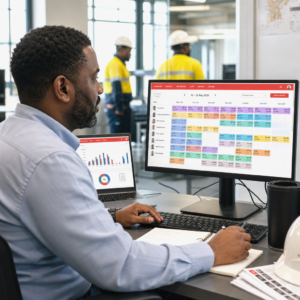
A mine manager needs a reliable picture of the workforce before the shift begins.
Who is expected on site? Which contractor teams are working where? Are the right people assigned to the planned work? Has attendance been captured consistently? Are supervisors working from the same information as HR, payroll and contractor managers?
These questions sound basic. On a complex mining operation, they are rarely simple.
A typical operation may rely on several contractors and service providers at the same time. Security teams, cleaning crews, maintenance contractors, transport providers, catering personnel and specialist technical resources may all work alongside the mine’s own employees. Each group can have its own supervisors, procedures, work patterns and systems for roster planning, attendance and communication.
The difficulty is not merely producing a roster. It is maintaining operational control when workforce information is spread across spreadsheets, paper registers, separate contractor records and disconnected attendance processes.
For mine managers, workforce management has become part of the operating discipline required to run a dependable site.
A fragmented workforce creates blind spots
Mining operations are used to managing complex assets, work plans and production constraints. Workforce processes often receive less attention until something goes wrong.
A late shift handover, missing attendance record or contractor deployment change can seem like an isolated administrative issue. In practice, it may create a wider gap in the operational picture. Supervisors may not have a confirmed view of who arrived for work. HR may be reconciling different records after the fact. Payroll inputs may need to be checked against information held elsewhere. Managers can spend time resolving discrepancies rather than dealing with the work in front of them.
The risk grows as the number of contractors increases.
One contractor may submit attendance data after a shift. Another may use paper registers. A third may plan work through its own rostering system. If the mine has no connected way of bringing key workforce information together, the management team must rely on manual follow-up and individual relationships to build a complete view.
That approach does not scale well. It places too much dependence on people remembering to send the right information in the right format at the right time.
Mine managers need to be able to ask straightforward questions and receive dependable answers:
- Which people and contractor teams were planned for this shift?
- Who actually reported for duty?
- Where were they assigned?
- Which supervisors have confirmed changes to the plan?
- Is the information available to the people responsible for workforce planning, site operations and payroll administration?
When those answers are slow, inconsistent or difficult to verify, decision-making suffers.
Contractor oversight requires shared discipline
Contractors are essential to many mining operations. They bring specialist capability, flexible capacity and services that support the mine’s core activities. The challenge is creating a consistent operating model without trying to force every service provider into the same internal process overnight.
The mine needs a common level of visibility across the workforce, regardless of employer.
This means agreeing how people are rostered, how attendance is recorded, how changes are communicated and how information moves between supervisors, contractor managers and mine management. The purpose is practical: to reduce ambiguity around planned and actual deployment.
A connected workforce-management environment can support this discipline by bringing rosters, attendance and workforce records into one place. It can give authorised managers a clearer view across sites, departments and contractor teams, while allowing individual service providers to manage their own people within an agreed framework.
For example, if a contractor team is redeployed because of an operational change, the relevant supervisor needs a workable way to update the plan and communicate it. The mine manager needs confidence that the revised information is visible to the people who need it. HR and payroll teams should not be left reconstructing the change days later from messages and handwritten notes.

Workforce data supports better operational decisions
Mine managers make decisions under pressure. Production plans change. Equipment availability affects work schedules. Weather, access restrictions and contractor availability can alter the day’s priorities with little warning.
A workforce-management process cannot remove these pressures. It can give management a firmer base from which to respond.
When planned rosters, actual attendance and deployment information are more consistently captured, managers can identify gaps sooner. They can see where an expected contractor team has not arrived, where a shift has changed, or where a supervisor needs to resolve an issue before it affects the wider work plan.
This is particularly important where operations span multiple areas or sites.
Workforce data also affects commercial control. Inconsistent attendance records create extra work when payroll-related inputs are prepared and reconciled. Poorly controlled processes can lead to disputes over hours worked, deployment records or contractor invoices. A clearer record of planned and actual workforce activity can make these discussions more factual and less time-consuming.
No system replaces sound supervision. It does, however, give supervisors and managers a more consistent record to work from.
Audit readiness begins with ordinary daily records
Audit readiness is often treated as a separate exercise. In reality, it depends on the quality of routine operational records.
If workforce data is assembled only when someone asks for it, the team is already working from a weak position. Records may be incomplete, held by different parties or difficult to trace back to the original shift plan. The result is a familiar scramble through spreadsheets, emails, paper files and contractor submissions.
A better approach is to manage workforce information as an operational record from the start.
That includes clear rosters, attendance information, controlled changes and an accessible history of who recorded or approved key updates. It also requires defined responsibilities. A system will not fix uncertainty about who owns a process, but it can make responsibilities and exceptions more visible.
For mine managers, this creates a more dependable basis for internal review, contractor discussions and governance processes. It also reduces the disruption caused when a question arises weeks or months after a shift has taken place.
Modern workforce expectations matter too
Operational control is the immediate concern, but workforce expectations are changing across Southern African mining.
Employees and contractor personnel increasingly expect mobile access to work-related information. They want clearer communication about shifts, changes and administrative requirements. Supervisors need practical tools that work outside an office environment, rather than another process that requires manual follow-up at the end of a long day.
Mobile workforce access can support more direct communication between management, supervisors and employees. Used properly, it can make it easier to share roster information and operational notices with the people affected.
Financial wellness may also form part of the wider employee proposition. EasyRoster’s Paymenow partnership can be relevant for organisations looking to give eligible employees access to financial-wellness services. It should sit within a broader approach to workforce engagement, not distract from the core need for accurate workforce planning and attendance information.
Building a stronger workforce-management foundation
Mining organisations need workforce processes that reflect the reality of contractor-heavy, multi-shift operations.
For a mine manager, the starting point is simple:
- Map where workforce information is currently created, changed and stored.
- Identify where contractor records do not align with site processes.
- Agree the minimum information required to manage planned and actual deployment.
- Give supervisors practical ways to record attendance, changes and exceptions.
- Bring roster, attendance, communication and payroll-related information into a connected workforce-management environment.
EasyRoster supports mining and service-based organisations with workforce-management capabilities including rostering, time and attendance, mobile access, workforce communication, reporting, contractor workforce management and payroll-related data. The aim is to give operational teams a clearer view of the workforce without adding unnecessary complexity.
The mine that can see its workforce clearly is better placed to manage the day when plans change. In a contractor-intensive environment, that visibility is part of dependable operational control.
Bring workforce information into clearer view
If fragmented rosters, attendance records and contractor processes are making it harder to manage workforce deployment, EasyRoster can help you assess a more connected approach.