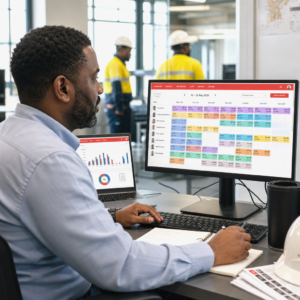
Workforce management in mining succeeds or fails on tight control of work taking place around the mine. Remote sites, multiple crews, continuous shifts, night work, contractors, qualification constraints, site-access requirements, and constant payroll and compliance pressure leave little room for fragmented processes.
When planning and attendance are split across different systems, small exceptions turn into coverage gaps, payroll errors, and compliance issues. The process is far more reliable when four fundamentals stay in control: coverage, compliance, communication, and visibility.
Where disconnected scheduling and attendance processes create operational risk
The key workforce management in mining planning questions should be easy to answer: who is scheduled, who is actually on site, how many hours have been worked, and which workforce planning exceptions need action now?
When mining staff scheduling, attendance, and payroll processes sit in separate systems, gaps open quickly. A shift stays unfilled longer than expected. A worker is double-booked. An absence sits too long before a supervisor can replace it. Qualification or site-access conflicts show up after the roster is published. Overtime drifts because worked hours and rostered hours are hard to compare in one place.
These are common workforce management challenges across all industries that also apply to mining. One team rarely owns the whole problem. Planners, operations supervisors, HR, payroll, and site administration each hold part of the picture. Without a connected view, exceptions take longer to spot, longer to act on, and longer to reconcile.
The four fundamentals that matter most for workforce management in mining
- Coverage
Coverage means filling shifts reliably across sites, crews, and times of day. In mining, that includes continuous operations, night work, and the practical job of matching available people to the right location and assignment. Coverage starts with the roster and continues through every absence, change, and redeployment that follows.
Strong coverage planning sits at the centre of mining shift scheduling and day-to-day operational continuity. Teams need a controlled way to identify gaps, assess replacements, and keep the roster current as conditions change.
- Compliance
Compliance depends on applying business rules, contracts, qualifications, and time-related controls consistently. Effective compliance depends on correct configuration of these contracts, rules, locations, and workforce data in the system to become active controls.
- Communication
Mining operations rely on timely communication between planners, supervisors, crews, contractors, and site administrators. When a shift changes, the update has to reach the right people quickly. When an absence occurs, replacement options need immediate action without waiting for multiple calls, messages, or spreadsheet updates.
Disciplined planning and communication matter especially in demanding 24X7 shift environments. Clear communication around the rosters helps teams respond earlier and with more consistency.
- Visibility
Visibility means seeing planned rosters, attendance status, hours worked, and exceptions in one place. Without that, teams spend too much time reconciling versions instead of dealing with issues. Better visibility supports faster decisions, clearer reporting, and more accurate payroll outputs.
In operational terms, this is about improving labour visibility in mining operations so those responsible can act before issues grow into larger disruptions.

How connected digital rostering improves planning discipline and accountability
A connected digital rostering approach links roster generation, attendance visibility, reporting, payroll exports, and mobile communication. The operational gain is straightforward: fewer manual workarounds and better traceability.
EasyRoster is an example of a workforce management system. EasyRoster supports roster creation, workforce scheduling across locations, attendance tracking, reporting, contract management, payroll exports, cloud access, and mobile access.
For teams reviewing mining rostering software, the practical question is whether the system supports control across planning, execution, and review. That includes mining shift scheduling and attendance management, as well as mining attendance tracking and roster management in one connected process.
Take an unfilled night shift. A planner identifies the gap, searches the system for a qualified replacement at the right location, notifies the worker through mobile access, updates the roster once confirmed, and captures attendance against that assignment. The record then supports reporting and payroll export. That process is more controlled than moving between calls, texts, spreadsheets, and separate attendance records.
This kind of connected workflow also helps with reducing scheduling errors in mining operations, especially where site access, qualifications, and location rules need quick checks.
Results depend on sound configuration of business rules, contracts, locations, access conditions, and internal processes. Connected software strengthens discipline and accountability when the operating model behind it is clearly defined.
Applying proven shift-workforce practices from other industries to mining
Mining does not require entirely unique workforce-management principles. Many proven practices from other shift-based industries apply directly: standardised scheduling rules, centralised labour visibility, reduced manual handoffs, and better exception management.
These are proven workforce management practices for mining sites because they improve operational control. They also fit workforce planning for complex mining shift environments, where multiple constraints need to be balanced without losing visibility or accountability.
- The decision criteria are practical:
- Can the system support reliable coverage?
- Does it make accountability clearer across planners, supervisors, HR, and payroll?
- Can it reflect business rules and contract conditions in a controlled way?
- Does reporting make hours, attendance, and exceptions easier to review?
- Is there an auditable record of roster changes and payroll-relevant outputs?
- Can workers and supervisors access key information through mobile tools?
For mining environments, those questions matter more than a checklist of software features. They help show whether the proposed digital rostering for mining companies supports genuine control or simply digitises fragmented processes.
Conclusion
If your mining operation is still managing rosters, attendance, and payroll inputs across disconnected tools, it may be time to tighten the fundamentals. EasyRoster helps operations teams bring scheduling, workforce management in mining, visibility, and attendance control into one practical process. If you want to see how that could work in your environment, book a demo with the EasyRoster team.